
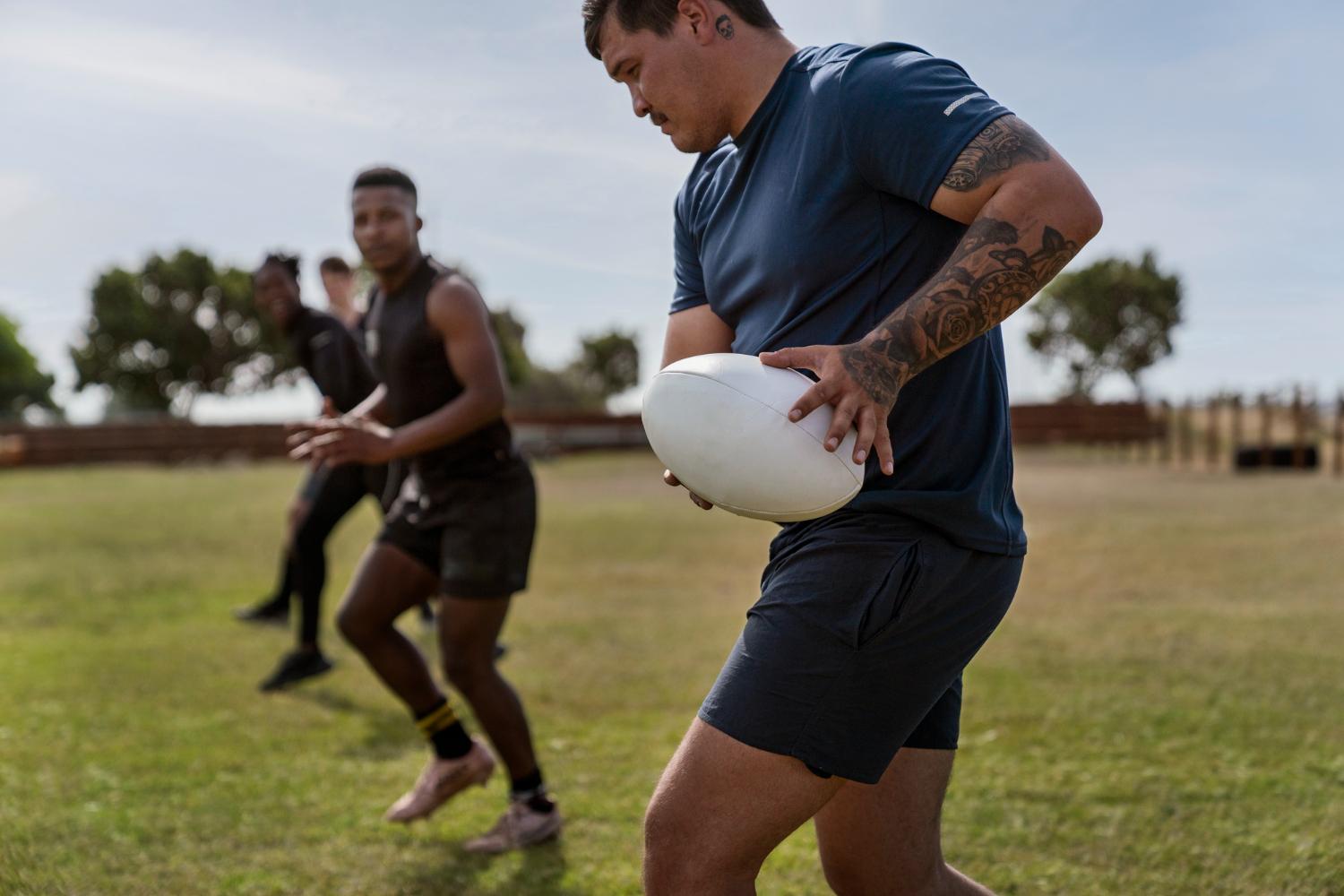
Alt: rugby players train on a field
Officiating has been a local business for as long as television has covered rugby. The Television Match Official sat at the ground, working with the screens, feeds and goodwill the host broadcaster brought that week. World Rugby confirmed the break from that on 7 July, announcing that the video officials appointed to its Nations Cup would call those matches from a single room instead, and the news travelled well past the refereeing forums. The audience reading it is not confined to one language either, with phrases such as کد هدیه وان ایکس بت circulating among followers of the same fixtures. Officiating consistency has always been a pricing input. This changes how it gets delivered.
What Moved Into A Single Room
Until this summer the video official went where the match went, working on location with whatever each venue and broadcaster had assembled. The governing body’s answer was to bring the TMOs appointed to the competition into one facility, built with Hawk-Eye at the company’s Basingstoke headquarters. Referees and their assistants stay pitchside. Only the screens moved.
What the hub adds is less about access than about where the work happens. Independent access to every broadcast angle has been operational inside World Rugby competitions since 2015, and the hub carries that forward rather than inventing it. New to the desk are split screen and zoom functions, pointed at grounding and in-touch rulings, the two calls that decide if points go on the board at all. Remote Foul Play Review Officers at the 2023 and 2025 World Cups had already shown the distance was workable.
A timing coincidence is worth noticing. The role of the TMO stopped being a global law trial on 1 July, written into full law after the Council met on 17 June and applying to competitions starting after that date. The position gained permanence in the law book and a new address inside the same fortnight.
The Four Standards And The Deadline
Alongside the hub, World Rugby set out what an international competition needs in place to use its TMO services. That carries an August 2027 deadline, which lands ahead of next year’s men’s World Cup. Competitions outside its own remit are encouraged rather than obliged, and have been urged to move sooner.
| Standard | What it requires |
| Camera access | Every angle available to broadcast goes to the TMO and Foul Play Review Officer |
| Feed control | Images shown to the referee come from the TMO station, under the TMO’s control |
| Operator qualification | TMO and FPRO operators accredited through World Rugby’s course |
| Provider capability | Technology suppliers able to support full, efficient review of all footage |
None of that reads as drama. It is a floor, and the intent behind it is plain enough. An official can no longer be shown less than the audience at home.
Why Review Length Shows Up In Odds
A review is dead air for the crowd and heavy traffic for a trading desk. Markets suspend, prices get recalculated against the likely ruling, and everything reopens when the referee raises an arm. Reviews that resolve faster and land the same way twice hand traders a narrower band of uncertainty to work with, which is why an operator such as 1xBet follows officiating protocol as attentively as it follows a team sheet.
Try scorer markets carry the sharpest exposure to any of this. A grounding overturned three minutes after the celebration moves first scorer, anytime scorer and the handicap in one stroke. Total points lines feel it too, since a decision reversed on the fourth replay changes the number and the clock at once.
Where Provision Still Varies By Competition
World Rugby sets terms for its own tournaments. It cannot impose them on leagues it does not own, and it has said as much, encouraging adoption rather than demanding it.
So a split remains, and the standards describe it by implication. A rule requiring every broadcast angle to reach the official, and requiring the official rather than a host director to control what the referee sees, only needs writing down where that is not already how things run. Coverage of a Champions Cup semi-final on 3 May turned on that exact question of angle availability.
For anyone pricing a club fixture and an international on the same afternoon, those can be two officiating environments wearing the same badge. The club season opens on 25 September under whatever provision each competition has settled on for itself.
What The Next Twelve Months Decide
The hub arrived with an evaluation attached. World Rugby has described it as a step towards possible use at future events of its own, which makes this season’s data the deciding evidence rather than a formality.
Chief of Rugby Mark Robinson called officiating technology one of the sport’s most debated areas, and framed the reforms as first steps in a deeper review. Cost sits in that review beside accuracy, since the governing body has tied the hub directly to reducing what competition organisers spend. Between now and August 2027 the international game converges on one technical standard, while the competitions below it decide one by one how closely to follow.